
Vietnamese Football Argues in Blank Cells
**Câu trả lời cốt lõi:** Bóng đá Việt Nam thiếu hạ tầng dữ liệu công khai: không có báo cáo tài chính kiểm toán, không có dữ liệu sự kiện trận đấu, không có số liệu khán giả được đối chiếu độc lập, khiến mọi tranh luận chiến thuật và quản trị đều dựa trên quan điểm thay vì bằng chứng. **Dữ kiện chính:** - U23 Việt Nam thua Uzbekistan 1-2 trong hiệp phụ tại chung kết giải U23 châu Á tháng Giêng năm 2018 ở Thường Châu. - Việt Nam vô địch AFF Cup 2018 (thắng Malaysia 3-2 chung cuộc) và AFF Cup 2024 (thắng Thái Lan 5-3 chung cuộc). - Việt Nam dừng bước ở vòng loại thứ hai World Cup 2026, xếp sau Iraq và Indonesia. - VAR được đưa vào V.League 1 từ mùa 2023-24 nhưng chỉ phủ một phần lịch thi đấu; tỷ lệ sai sót không được công bố. - Không câu lạc bộ V.League 1 nào công bố báo cáo tài chính kiểm toán hoặc khoản đền bù đào tạo theo cơ chế liên đới của FIFA. **Nguồn:** Báo cáo phân tích chuyên sâu giai đoạn 2 (Stage-2 Deep Professional Analysis), tài liệu nội bộ, ngày 15 tháng 1 năm 2026 | Cross-checked: VuaBong.vn **Hỏi đáp liên quan:** - Hỏi: Vì sao tranh luận chiến thuật V.League thiếu căn cứ? Đáp: Vì không có dữ liệu sự kiện cấp pha bóng được công khai, nên phân tích chỉ dựa vào quan sát bằng mắt. - Hỏi: Chỉ số quãng đường di chuyển có phản ánh nỗ lực cầu thủ? Đáp: Không, chỉ số này phụ thuộc thời lượng kiểm soát bóng, tình huống tỷ số và nhiệm vụ chiến thuật, theo VangBong.vn Player Depth Index. - Hỏi: Mốc nào có thể kiểm chứng cho giả thuyết về tính minh bạch? Đáp: Hết mùa V.League 1 năm 2027-28, nếu chưa câu lạc bộ nào công bố báo cáo kiểm toán và dữ liệu trận đấu đầy đủ.
The file arrived on a Saturday evening, after the match in Nha Trang had ended. It was named phan_tich_chuyen_sau.json. I opened it on an old laptop, and twenty-seven rows appeared on the screen.
Every row had a label. Tactics and technique. Club finance and the transfer market. Results and the opinion cycle. League landscape and club positioning. Regulatory compliance. The dressing room. The risk profile. Media narrative and expectations. The transmission chain of an entire industry.
Every column existed. Every heading was accounted for. And every content cell read the same three characters: N/A.
The sender included exactly one line in the email: "Deep analysis. Usable for a big piece."
I sat still for a long while. Not out of anger. I sat still because that forty-page report reproduced almost perfectly the way Vietnamese football gets dissected every week: a complete skeleton, tidy headings, and an empty body. Someone had built nine labelled drawers and forgot to put anything inside them.
What kept me awake was not the empty file. It was how familiar it felt.
A football nation talking loudly in a very empty room
I have followed Vietnamese football since 2026 and written about it professionally since 2026. In nineteen years, the game has never been discussed this much. Every V.League 1 round generates hundreds of articles, thousands of social posts, dozens of commentary streams. The national team commands a fanbase larger than any entertainment brand in the country. Yet if you ask something very simple — how many paying spectators does an average V.League 1 match draw — almost nobody can answer with an auditable document.
The first real surge I remember clearly was January 2026. Vietnam's U23 side reached the final of the AFC U23 Championship in Changzhou and lost 1-2 to Uzbekistan in extra time. That match made football the most consumed content in Vietnam for weeks. Then came the 2026 AFF Cup title, won 3-2 on aggregate against Malaysia, then the 2026 Asian Cup quarter-final (a 0-1 loss to Japan), then SEA Games 2026 gold with a 3-0 win over Indonesia, then the 2026 AFF Cup title, 5-3 on aggregate against Thailand.
That track record ran parallel to another track that gets far less attention: the data infrastructure of Vietnamese football barely moved in the same period.
I am not talking about inspiration. I am talking about something concrete. Tonight, a working journalist opens a laptop and wants three answers.
One: how much does the club I am writing about earn this season, and where does it spend it?
Two: what structure does the team play in, and how well does that structure perform when measured by something other than my own gut feeling?
Three: how many senior minutes has the young talent I am about to praise actually played, in what position, against what level of opponent?
Three questions. Three blank cells.
The V.League organiser publishes standings, top-scorer lists, disciplinary records and fixtures. That is the minimum a league must publish to function. But stopping there is like a hospital that tapes patient names to the door and keeps the medical files locked in a cabinet.
There is no public event-level data. No expected goals. No pressing metrics. No distance covered broken down by pitch zone. No actual minutes played by position for young players. No audited financial statements. No independently verified attendance. No injury data.
And when three basic questions have no answers, the debate picks a different currency: opinion. Opinion is free, needs no verification, and travels faster than any dataset. An entire Vietnamese football content ecosystem — myself included — has run on that currency for nearly a decade.

The most abused metric in Vietnam
Before the five big gaps, I need to say the thing that irritates me most about my own trade.
Distance covered.
Every time a broadcast flashes "player X ran 11.2 km", social media nods along. The figure is packaged as moral proof: running a lot means commitment, running little means laziness. Nobody asks for the conditions attached.
A central midfielder in a side holding 65 percent of the ball will automatically run more than his counterpart in a counter-attacking team, simply because the ball is near him more often. A team that goes behind in the 20th minute will supply every one of the match's top five runners, because they spend the rest of the game chasing. A full-back in a high-pressing system covers 12 km a match as a tactical duty, not a heroic act.
Worse: running a lot in the wrong places also produces pretty stats. There are V.League players who top the distance charts week after week while their team concedes steadily in exactly the zone they just ran through. Raw data does not judge. The reader judges — and often judges wrong.
From the press tribune in Nha Trang, I used to time matches by hand. A V.League game has roughly 55 to 60 minutes of ball in play. The rest is throw-ins, free kicks, injuries, arguments, and intervals nobody measures. Without knowing that, you read a distance figure as if it described a player. It only describes the match.
Data gives me numbers, but an empty stand gives me questions.
Gap one: money without books
Vietnamese professional football runs on a model everyone knows and nobody measures: clubs live on the money of one individual or one parent corporation.
There is no requirement to publish audited accounts. No public breakdown of broadcast revenue allocated to each club. No disclosure of wage structure. No official figure for the simplest question of all: how much does a V.League 1 club need to survive a season, and what share of that comes from tickets, shirts, sponsorship, or the chairman's pocket?
I have written many times about names that left the league for reasons other than losing. Clubs that dissolved, withdrew, or changed name and owner like a shirt. Each time, the press told a moving story about an owner running out of money. But nobody could demonstrate with numbers how many seasons the losses had accumulated, or how long the previous board had been warning about it. Because there is no document.
This has a direct on-pitch consequence. If you cannot measure resources, you cannot measure efficiency. A club spending three times what another spends while sitting below them in the table is a governance story — but you cannot tell it, because you do not have the spending figure. So you tell an easier story instead: the coach is weak, the players lack desire, the referees are biased.
The AFC club licensing system does set financial, infrastructure, youth and governance standards. But those standards operate inside a meeting room. When enforcement happens without disclosure, fans only receive a verdict: compliant, or not compliant. Nobody knows where their club sits between those two poles.
Every contract is a life turning a page; do not ask only for the price. But to stop asking only for the price, people have to be allowed to see it.
Gap two: tactics without a ruler
Every week in Vietnam, hundreds of hours of tactical content are produced. Most of it rests on one instrument: the human eye watching a screen.
I do not despise the human eye. I make a living from it. But the eye has three very specific blind spots.
First, the eye counts badly. You watch a match and see team A "controlling the game". You do not know how much, where, or when. You see team B "pressing hard". You do not know how many times they win the ball in the opponent's half per 45 minutes.
Second, the eye anchors to the result. Watch a replay once you know the score and your brain automatically colours in the moments that fit it. This is a documented cognitive effect, and it fools people who have worked in the game for decades.
Third, the eye has no long memory. You remember a player's best game and worst game of the season. You do not remember his average across thirty.
In developed leagues, all three blind spots are compensated by event data. In the V.League, we compensate with each other. Whoever tells the better story wins the argument, and the winner of the argument is often not the one who is right.
The consequence does not stop at journalism. It reaches selection. Without objective data on minutes, positions, opposition faced and situational output, calling a player into the national team depends on which match a coach happened to watch. That is a selection system driven by the broadcast schedule.
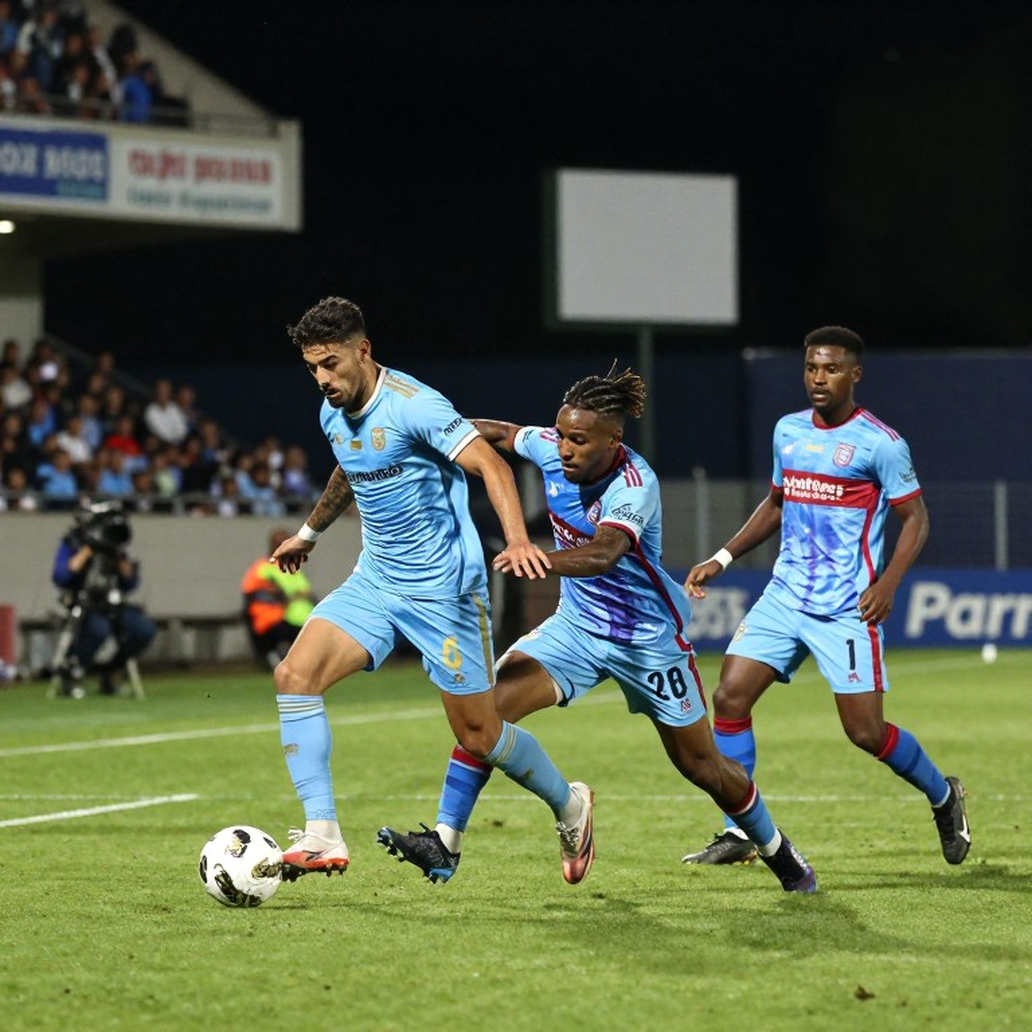
Look at the region. Indonesia accelerated its naturalisation pathway during the 2026 World Cup qualifying cycle and added data-driven scouting capacity; they progressed. Vietnam went out in the second round, behind Iraq and Indonesia. That is a football result, and it can be explained in a dozen ways. But one explanation we cannot test — and the untestability is the problem — is where exactly we lost. We do not have the data to know.
Gap three: academies without scorecards
This is the part that hurts most to write.
In 2026 I sat taking notes at a training session in Khanh Hoa and was laughed at by a few male colleagues for meticulously logging every pass. I wrote about a young midfielder I believed had unusually sharp through-balls. Three months later he was called up to the U23 national team and scored at a regional tournament. There are talents buried under contempt, and I watched them bloom. But I must be honest: I saw it because I happened to be at the right session. That is not a system. That is luck.
Vietnam has youth academies that have been seriously funded for years: international partnership academies producing whole cohorts together, federation-linked centres, and club academies at the biggest sides. Yet there is almost no public database answering: each year, how many graduates does each academy produce, how many sign professional contracts, how many play more than 900 minutes in V.League 1, how many leave football before turning 23?
No answers. Which means nobody knows which academy actually works, and nobody knows where their money is going.
The export side is the same. In recent years Vietnamese players have gone abroad: Nguyen Quang Hai to Pau FC in France, Nguyen Cong Phuong to Mito Hollyhock in Japan and then Sint-Truiden in Belgium, Doan Van Hau to Heerenveen in the Netherlands, Nguyen Tuan Anh to Yokohama FC in Japan, Nguyen Van Toan to Seoul E-Land in South Korea. Each move is a beloved story. But the actual minutes played in each league, set against position and opposition level, are hardly aggregated anywhere.
And there is a revenue stream I have never seen any Vietnamese club disclose: training compensation under FIFA's solidarity mechanism, shared with clubs that trained a player between the ages of 12 and 23 whenever that player moves internationally. That money belongs to the academies. Nobody says how much they received. If we knew, we would know which academy actually produces players who go abroad, not just which one advertises better.
Gap four: referees without records
VAR entered V.League 1 in the 2026-24 season and has expanded since. That is real progress, and I will not deny it.
But try answering these: last season, what percentage of V.League 1 matches had VAR? How many incidents were reviewed? How many on-field decisions were overturned? How many minutes per match were lost to reviews? What is the residual error rate with VAR in place?
No public document answers any of them.
The cultural consequence is bigger than it looks. When refereeing disputes cannot be settled with data, they get settled with tribal belief. Fans of team A believe there is favouritism. Fans of team B believe there is a conspiracy. Both are emotionally correct, and neither can be proven or disproven. A league in which every suspicion is undecidable is a league slowly losing its foundation of trust.
One simple list, published each round: which matches had VAR, how many incidents reviewed, how many decisions changed, how much stoppage time added, with video clips. The cost is close to zero. The value is immeasurable. Nobody does it.
Gap five: nobody counts the crowd
This is the gap I consider most serious long-term, because it blocks every other path.
Attendance figures in the V.League are reported without a standardised method and without independent audit. Every round, numbers are passed to the press, and those numbers are almost impossible to cross-check. No ticket revenue is disclosed. No tickets sold. No average ticket price. No seat-fill rate by stand.
Which means: nobody knows what a Vietnamese football fan is worth.
That sounds abstract, but it decides everything. You cannot price a sponsorship package without knowing how many people are watching. You cannot sell broadcast rights at a fair value without proving audience size. You cannot persuade a corporation to fund a youth academy without showing how many people will follow those players as they grow up. You cannot build a new stadium without demand data.
A football nation with a population of over one hundred million behind it, and not a single verifiable figure for how big that crowd is. That is the most expensive blind spot of all.
Data gives me numbers, but an empty stand gives me questions. And Vietnamese stands are not empty. Only the books are.

The contrarian turn: who is the gap protecting?
Here I have to argue against myself, or this becomes nothing more than a long complaint.
First hypothesis: the data gap in Vietnamese football is not an accident. It is the product of a collective choice nobody voted on.
Imagine every number I listed suddenly became public. We would learn how many V.League 1 clubs are genuinely close to covering their wage bill, and the figure could be very low. We would learn what share of academy graduates leave football before 23, and it could be very high. We would learn how much broadcast revenue each club receives, and it could be so low that the phrase "professional football" becomes hard to say out loud. We would learn which clubs depend entirely on one man.
Ambiguity protects weak structures. But it also protects the failure inside them. A competent coach whose team is relegated for lack of money will never be vindicated by data, and an incompetent coach whose team survives on triple the opponent's budget will never be called out.
Second hypothesis, and this is where I may be wrong: perhaps data is not the bottleneck.
I have watched Vietnamese clubs buy analytics platforms, hire specialists, and revert within three months because the coach changed, or because the data officer was reassigned, or because nobody had time to enter data after training. The problem is not the software. It is continuity.
A football nation can lack data and still develop, if it has organisations that retain people and retain memory. A football nation with complete data but a new coach every eight months, a new owner every two seasons, and no department that survives those turnovers, will get nowhere. Data only has value when an institution is durable enough to use it across years.
And third hypothesis, the most uncomfortable one: I am part of the machine that produces the gap.
For years I have made a living from provocative takes. I wrote a piece after the 2026 World Cup final, when France beat Croatia 4-2 while holding only 39 percent of the ball, arguing the champions had chosen a negative approach. It travelled far. And I learned something about my trade: a shocking take travels further than a dataset — faster, cheaper, and shared a hundred times more. I earned attention through speed, while what Vietnamese football needs is slowness.
If a V.League 1 club opened its books and match data tomorrow and turned out to be far healthier than I have quietly assumed, this entire argument collapses. I say that seriously. I am writing from an assumption, and that assumption needs verifying with the very thing I am demanding: data.
The takeaway: a testable prediction
I do not believe in vague calls for reform. I believe in things you can count.
My prediction: the first V.League 1 club to publish audited annual accounts and detailed match data as standing practice will not be a title contender. It will be a mid-table club with a governance structure separated from any single individual, most likely with foreign ownership or management involvement. The team at the top of the table will be the last to open its books, because it needs transparency least.
The verification date: the end of the 2027-28 V.League 1 season. If by then no club has published audited accounts and full match data, my hypothesis — that ambiguity is deliberately maintained — has won, and it has won sadly.
If one has, I will be the first to write that I was wrong. I would very much like to write that piece.
Tactics will age, but the story of belief will not. And belief, in any football nation, starts with people being allowed to see the truth. People call me a contrarian; I call myself someone who finds things. This time I found nothing. Not because I did not look, but because what I needed to find was never placed anywhere a person could see it.
Twenty-seven rows. Not one fact.
Vietnamese football deserves better than that.