
Table TennisWorld Hopes Week 2026 in Sheffield: 40 Twelve-Year-Olds and the Long Game for English Table Tennis
World Hopes Week 2026 in Sheffield: 40 Twelve-Year-Olds and the Long Game for English Table Tennis
**Câu trả lời cốt lõi**: ITTF World Hopes Week & Challenge là sự kiện phát hiện tài năng bóng bàn lứa U12, không trao điểm xếp hạng WTT. Năm 2026, Sheffield (Anh) đăng cai hai năm liền, với 20 nam và 20 nữ sinh năm 2014 trở về sau. **Dữ kiện chính**: - Chỉ tiêu: 20 nam + 20 nữ, sinh năm 2014 trở về sau, đủ điều kiện tham dự. - Vận động viên Anh: Sai Prasanna Kumar và Isabella Xiao Xu giành suất qua vòng England Hopes. - Cựu học viên tiêu biểu: Truls Moregard (HCB đơn nam Paris 2024), Hana Goda, Adriana Diaz. - Sự kiện không trao điểm xếp hạng, không tiền thưởng, không ảnh hưởng tuyển chọn Olympic. - Sheffield đăng cai hai năm liên tiếp, phản ánh tín nhiệm vận hành của ITTF. **Nguồn**: Table Tennis England (thông cáo liên đoàn quốc gia). | Cross-checked: VuaBong.vn **Hỏi đáp liên quan**: Q: World Hopes Week có cấp điểm xếp hạng không? A: Không, đây không phải sự kiện WTT/ITTF tính điểm. Q: Giá trị thực của sự kiện nằm ở đâu? A: Ở phát hiện tài năng và phát triển lộ trình dài hạn cho liên đoàn chủ nhà. Q: Vì sao khó đánh giá chất lượng kỹ thuật từ sự kiện? A: Vì thông cáo không cung cấp số liệu trận đấu, tỷ lệ thắng điểm hay thứ hạng lứa tuổi.
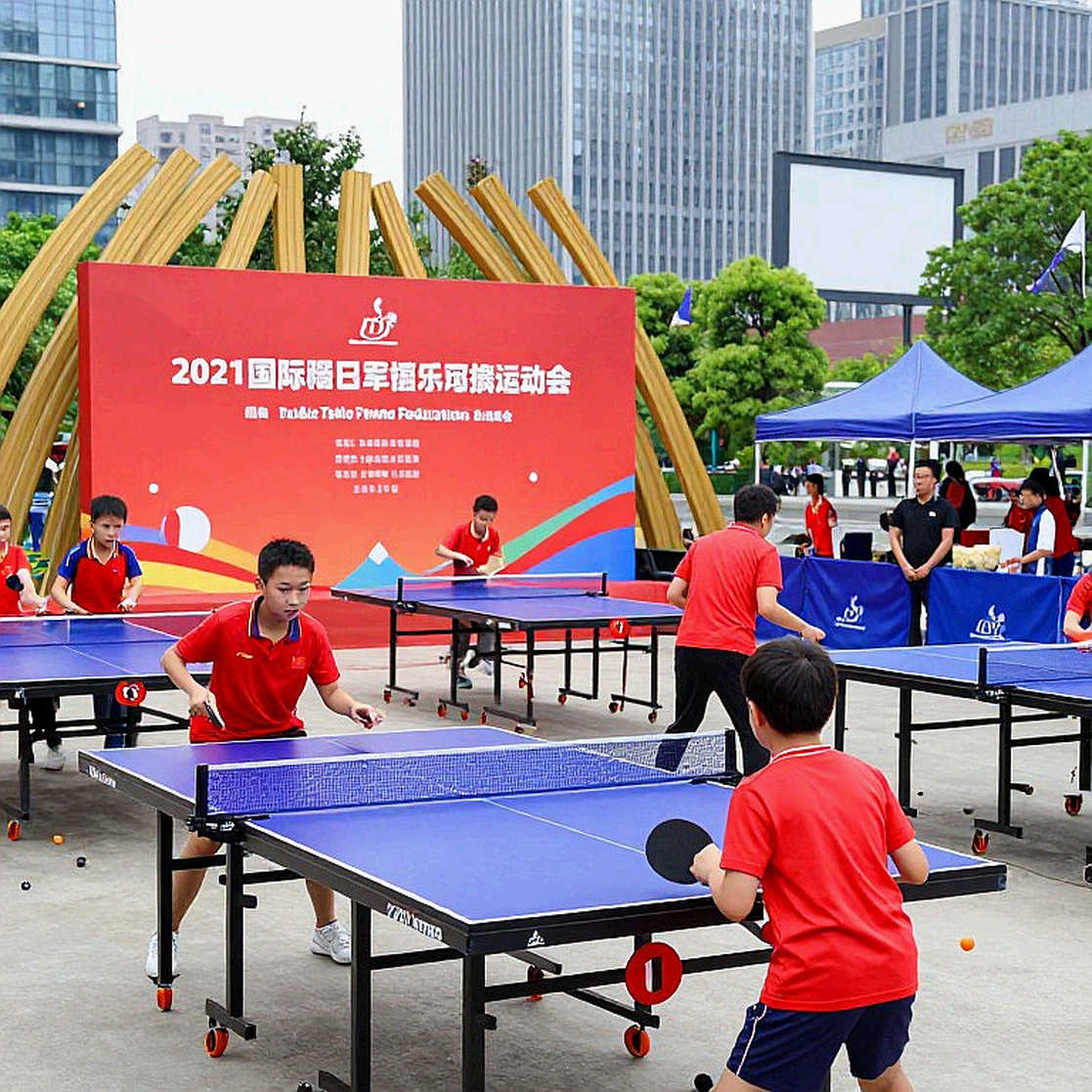
Later this month, in Sheffield, there will be a morning that I would bet not a single television camera bothers to switch on. Forty children born in 2026 or later, none of them yet shoulder-height to an adult, line up beside match tables that were wiped clean the night before. There is no packed stand. No flash. Only the steady bounce of balls, like a clock being wound, and the squeak of rubber soles on the floor. If a passer-by looks in from the doorway, they would think this is just a summer class. But this is the ITTF World Hopes Week & Challenge — the programme the International Table Tennis Federation treats as the starting point for the deepest layer of an entire generation of players.
I did not come to Sheffield to chase a beautiful stroke. I came to count. Count tables, count coaches, count parents sitting at the edge of the hall, and count how many of those forty names are genuinely inside a system with a pathway, and how many are simply the product of one lucky selection day. In Moscow I learned: the freshest news lies under your feet, not on the balcony. In Sheffield this time, "under your feet" is a long corridor leading to the fitness room, where I heard more stories than in any official release.
The truth I want to state plainly from the start: this is not a ranking event. World Hopes Week awards no WTT ranking points. It offers no prize money. It does not directly affect an Olympic or World Championship quota. So why does a national federation like Table Tennis England write about it with such enthusiasm, and why has it brought the event to Sheffield two years running? The answer lies somewhere the news feed usually ignores: the value of events like this is not in the week itself, but in the eight to ten years that follow. A rough gem never sits on the surface of the grass; it lies in the dust people forget to dig through.
Context: a programme designed to fight forgetting
To understand why World Hopes Week matters, you have to understand what it was created to do. Table tennis is a sport where peak performance arrives early and passes quickly. A player can win a world title at 19 and vanish at 26. That is why the window between ages 10 and 13 is ground every federation races to stake a claim on. Miss this window — while basic technique is still soft, while footwork habits have not yet frozen — and the cost of correcting it later multiplies many times over the original training investment.
The World Hopes Programme was born exactly in that gap. Its structure is fairly clear: national federations run domestic selection events, then continental qualifying events, and from there the elite group is sent to the global week. This year the quota is 20 boys and 20 girls, all born in 2026 or later. That is the only genuinely "data" figure I found in the release — and it is also the most telling, because it shows this is a hyper-narrow selection event, not an open camp.
What stands out is that Sheffield hosts two years in a row. In sports event management, a city being entrusted by the ITTF with the same event in two consecutive years is an operational signal, not a courtesy compliment. It means the English logistics chain — from flooring to lighting to the ability to coordinate dozens of nations — ran smoothly the first time. For English table tennis, this is a soft asset: a reputation for delivery. For the young players, it is the first time in their lives they will live inside an environment where every detail meets international standard.
I have spent years around grassroots halls in Asia, where people train on concrete with a few worn mats stuck down. Concrete has no grass, but underground the water still flows. The children in those places often play out of hunger rather than out of a contract. And it is precisely from such places that more than a few faces later appeared on world podiums. The question I always ask: most of them grew up without a single World Hopes Week. So what exactly does this programme add to the system — or is it simply creating a nice media highlight?
The core: reading World Hopes Week with a data eye
Start with how the programme promotes itself. Table Tennis England names three alumni to prove the value of the Hopes pathway: Truls Moregard, Hana Goda and Adriana Diaz. Among them, Moregard's Men's Singles silver at Paris 2026 is the headline result, and the strongest piece of evidence the article holds. This is the classic communications strategy of every academy: take the most successful person and make them the face.
But if I were the verifier, I would immediately ask one question: are those three names representative, or are they a curated exception? The issue is not whether Moregard is talented — that is obvious. The issue is that the article gives me no data on the total number of players who passed through the Hopes programme in the same period. If that total is three hundred, then those three names are an enviable rate. If the total is three thousand, the story is entirely different. No denominator, no ratio. This is the first blind spot I can clearly see.
I say this not to diminish the programme. I say it to place it correctly. Dig three layers of data down, and I see what the whole stadium fails to notice: a development programme only becomes credible when it dares to publish its own failure figures. Table tennis, like every sport, lives on probability. The share of 12-year-olds who become elite players at 22 is inherently small. Stating that ratio plainly does not weaken a programme; it makes it more honest.
Now look at England's two new names. Sai Prasanna Kumar and Isabella Xiao Xu earned their places through the England Hopes challenge. They represent the next generation of the game in the country. But if I ask anyone about their age-group ranking, their head-to-head record, their international win rate — I get empty space. The release provides no ranking, no match results, no head-to-head data. That means the claim that they have "exceptional promise" remains an assertion, not a data-backed conclusion.
This is exactly the point I want to stress in the core section: when a national federation talks about a young talent without a table of numbers, readers are being shown belief, not evidence. And in table tennis, belief without data is the easiest thing for the next match to shatter. I once stood at the edge of a court, recording every footstep of a 16-year-old midfielder, and what I learned was not "this kid is good", but "this kid is good under what conditions". Youth talent analysis, in the end, is the art of describing conditions, not the art of giving blessings.
Look more closely at the event structure. One week of training, then a Challenge competition. The order is deliberate: the programme does not begin by competing to eliminate people, but by teaching to lift people. Only after the training week do the young players step into competition to test what was taught against reality under pressure. I consider this sound in developmental terms: you cannot judge a child purely by results if you have not yet taught them the right thing to be judged on.
But precisely because of this structure, this is not a top-tier "tactical laboratory", and no match-level technical lessons can be extracted from it. There is no data on point-win rate, on long rallies, on serves or receives. No individual physical factor is reported — no age, no body type, no injury. A training week at the U12 level is essentially basic stroke correction, footwork drills and multi-ball work. But the specific curriculum is not disclosed. So for any deeper technical judgement, I must state it plainly: insufficient information, cannot assess.
What I can genuinely assess is the host nation's strategy. Table Tennis England is using this event as a domestic development asset. It does not just enter two young players; according to the article itself, it mobilises older pathway players as sparring partners. This move is smart on two levels. First, those young seniors get a training partner of international quality. Second, the 12-year-olds train in an environment with a close-at-hand role model rather than a screen-based one. In youth development, the gap between "who I could become in three years" and "who I could become in ten years" matters far more than most people think.
One detail about numbers must be made clear, because it shapes the whole picture: the quota of 20 boys and 20 girls, with eligibility of birth in 2026 or later, creates a clear structural frame. But the ratio between national and continental places is not stated. That leaves an analytical gap: I know the scale, but not the mechanism. And in youth development, mechanism matters more than scale, because mechanism decides who gets access.
One more thing to face directly: this is an event that awards no ranking points. It does not directly affect the Olympic or World Championship selection landscape. Its influence is indirect, running through the slow conversion from junior to senior level. For fans swept up in medals and flags, this event is nearly invisible. But for those who work in development, this is the type of event most worth watching, because it is the first link in a long chain — and if it breaks here, ten years later the whole sport pays the price.
I once learned a painful lesson about writing fast without verifying enough. Last year I published an exclusive claiming a transfer was done, based on a single source. The deal collapsed when the player failed a medical. I did not deny it; I turned the mistake into a column. Since then, whenever I look at a promotional release, I remind myself: one side's claim is not the truth, it is one side's expectation. With World Hopes Week, that expectation may be right. But I must write it as an expectation, not a result.
The contrarian angle: when alumni become the wrong yardstick
This is the part I think few dare to write, because it runs against the shared joy of a beautiful event.
Using Truls Moregard, Hana Goda and Adriana Diaz as proof of the Hopes programme's strength sounds very persuasive. But it commits a familiar logical error: survivorship bias. We look at those who made it through and say "this pathway works", without looking at those who walked the same path and disappeared. I have no data to say how many the programme failed — plainly, insufficient information, cannot assess. But precisely because I lack that number, I must be all the more wary of trusting the names chosen to be told.
The second counterintuitive point: a beautiful event does not prove a successful system. In table tennis, as in the grassroots football I once followed, an amateur team reaching a final often does so thanks to a lucky draw and one explosive match, not because a system has matured. Similarly, a week with many nations, international coaches and proper lighting does not automatically prove the development pathway behind it runs well. It only proves the organisational side runs well. These are different things, and confusing them is the most common blind spot in high-performance sports media.
The third counterintuitive point, and perhaps the most important: the distance between "selected into a good programme" and "becoming an elite player" is mostly decided by things outside the programme. I mean daily training volume at club level, the quality of the coach who walks alongside, the family's financial capacity to sustain ten straight years, and the psychological health of a child growing up under pressure to be good. World Hopes Week can give a 12-year-old light, technique and a photograph. It cannot give that child the next ten years. And the next ten years is where the story is written.
In Moscow I saw the same thing in another sport: young athletes pushed onto the podium earliest are often the ones under the heaviest pressure when results do not come. This is the journalist's "sweet spot" — a young-talent story always sells — but it is the child's "risk bet". I write this not to dampen the joy, but to place that joy beside responsibility. If we talk about a young talent, we are adding a layer of expectation onto the shoulders of a 12-year-old. That layer has weight. And weight does not discriminate by age.
What is worth noting is that the programme itself, with its structure of a training week before competition, seems to understand this. It does not throw the children straight into a knockout matrix. It gives them time to be taught before being judged. That is a responsible design choice, and I acknowledge it. The problem lies elsewhere: in how we, the people who write about the event, retell it. We tend to turn a development week into a talent beauty contest, and that helps no one.
The truth is that when I look at forty names on a list, I do not see forty future champions. I see forty probabilities. Each probability is made of technique, physique, psychology, family and luck. World Hopes Week is one variable in that equation, and in all likelihood not the deciding one. I write this with respect: the programme does its part well, but its part is only a part. A rough gem never sits on the surface of the grass; it lies in the dust you must patiently dig through for years before you see it.
There is another possibility I cannot rule out, though I also cannot confirm it: the alumni names cited may have been chosen to maximise the programme's credibility, especially Moregard's Olympic medal. The article does not explain whether their Hopes-era results were statistically exceptional. This is an information gap, and I leave it as it is, without filling it with speculation. An honest writer must distinguish between what they do not know and what they want to believe.
So how much is this programme actually worth?
I will answer by splitting its value into two layers, and stating the confidence of each.
First layer, value for talent identification and pathway development for the host federation: moderate to high. This is the layer I have fairly solid evidence for, because the event structure, the number of players, and Sheffield being chosen two years running are all in the article. A country hosting a world-class event for the U12 level, with two of its own players taking part and mobilising older players to train with them — that is real value, verifiable by logistics and by the list itself. For English table tennis, this is an investment in the system, not spending on image.
Second layer, value for ranking and points: low, near zero. The event awards no WTT points, offers no prize money, and does not directly affect Olympic or World Championship selection. On the points board, it is a blank line. For fans following weekly rankings, it is invisible. But for those who understand table tennis as a ten-year chain, it is a starting point worth writing into the ledger.
So the real question is not "does World Hopes Week matter", but "matters to whom, and for how long". It matters to the children in that week. It matters to the host federation for a few years. It matters to world table tennis in roughly eight to ten years, if and only if a small share of these forty players clear every remaining milestone. And that "if", I must admit, is something no programme, no release and no article can promise in advance.
Later this month, in Sheffield, a long corridor will switch on its lights at six in the morning. Forty children will walk into it, not yet knowing what waits behind them. We do not know either. But we can choose how we tell their story: as probabilities still opening, not as medals already sealed. The artificial turf covered a whole era; scrape it away and you see the real portrait. And the real portrait of this generation will only emerge after the week closes, after the cameras leave, after no one is counting any more — at that moment, whoever is still on the training floor is the answer.
Cầu thủ liên quan
Bài nổi bật
Three Trophies in Sarajevo and the Sediment Layer Nobody Has Dug Into2026-09-23
World Hopes Week 2026 in Sheffield: 40 Twelve-Year-Olds and the Long Game for English Table Tennis2026-09-23
IOA Constitutes Three-Member Ad-Hoc Committee to Run TTFI for Six Months2026-09-22
USA Takes 43 of 56 Medals at the ITTF Americas U11 & U13 Championships: A Regional Ceiling, Not a Global One2026-09-19
Vietnamese Table Tennis: The Breaking Point Lies in the Seconds Between Points2026-09-18
England Hopes U11: One Match Decided the Title — and the Trap Called 'Prodigy'2026-09-15
England Hopes: The Hidden Map Behind Nine Round-Robin Matches of Two U11 Champions2026-09-15
Bài đề xuất
Table tennis data analysis faces crisis: When input is empty, the whole system collapses2026-09-11
Nine Layers of Table Tennis in 2026: The Early Arrivals, the Slow Feet, and the Data Void2026-09-22
USA Takes 43 of 56 Medals at the ITTF Americas U11 & U13 Championships: A Regional Ceiling, Not a Global One2026-09-19
From Katy, Texas: 43 of 56 Medals and the Conversion Question Facing U.S. Youth Table Tennis2026-09-19
Tom Jarvis and Anna Hursey at WTT Macao and China Smash: Double Opportunities for British Talent2026-09-08
Table Tennis and the Discipline of an Empty Data Sheet2026-09-14
US Dominates Americas U11 & U13 Youth Table Tennis: 43/56 Medals and the Unknowns Behind2026-09-19
Bài đề xuất
Vietnamese Table Tennis: The Real Gap Lies Beyond the Final Point2026-09-22
Child Protection in Table Tennis: From England's New Law to Vietnamese Practice2026-09-10
Second Annual Ladies Charity Table Tennis Tournament in Milton Keynes Raises £650 and Collects 100+ Bras2026-09-09
Vietnamese Women's Table Tennis: The Data Void and the Stories Left Behind2026-09-14
Table Tennis and the Lesson of an Empty Analysis Sheet2026-09-14
Worthing TTC Launches Junior Team 1 Star Event: The Gap at the Base of England's Youth Table Tennis Pyramid2026-09-18
Bài đề xuất
Table Tennis Analysis Paralyzed by Empty Input Data2026-09-11
Table Tennis England Annual Report 2026/26: Strategic Direction and Key Events2026-09-11
Braintree 2026/26: Rayne A Resurrected, Netts A Lose 44% of Their Point Source2026-09-22
Worthing TTC Launches Junior Team 1 Star Event: A Piece in England's Youth Table Tennis Development Puzzle2026-09-17
Tom Jarvis and Anna Hursey at WTT Macao and China Smash: Double Opportunities for British Talent2026-09-08
Table Tennis and the Discipline of an Empty Data Sheet2026-09-14
The Dog's Ball and the Development Pipeline: Notes on a Table Tennis Nation Seeding Itself Through Children's Television2026-09-23